
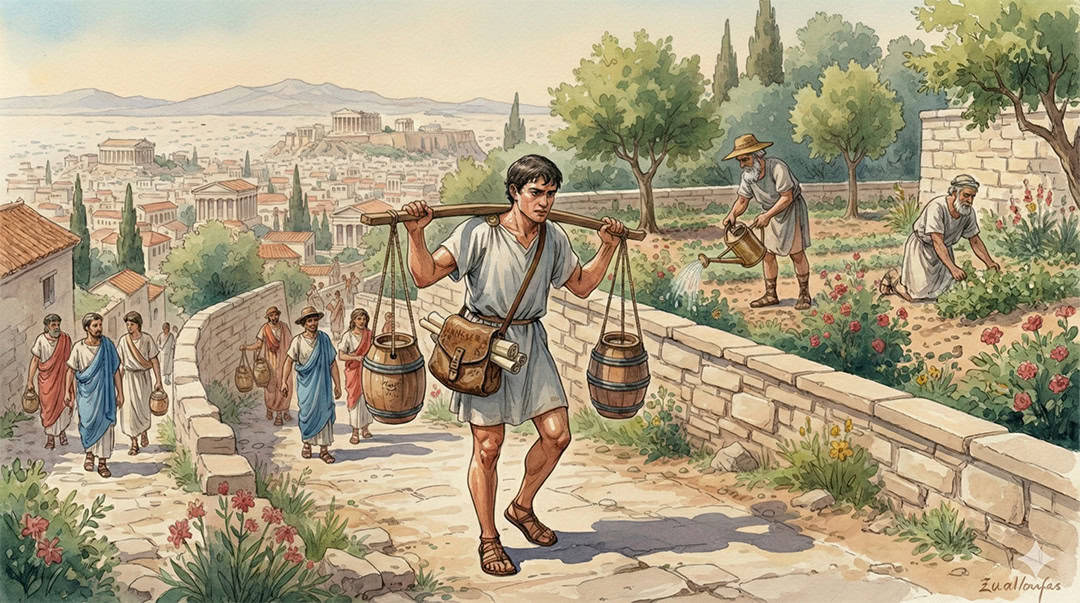
Full of Days: Learning from Cleanthes
Cleanthes was not the most brilliant Stoic, but he may have been the most grounded. He worked by night, studied by day, endured ridicule, and refused to be a burden to anyone. His life reminds me that quiet effort and modesty can leave a lasting mark.
I’m reading The Lives of the Stoics, and the second chapter—about Cleanthes—caught me more strongly than I expected.
After Marcus Aurelius and Musonius Rufus, he might be my favourite Stoic.
Not because he was the sharpest mind in the room.
Not because he dazzled anyone with brilliance.
But because he worked.
Cleanthes arrived in Athens poor and unremarkable. He studied philosophy by day and carried water by night. Literal water. Heavy buckets. Physical labour. He did this not as a gesture, not as a pose, but because he refused to be a burden on anyone. Philosophy, for him, did not cancel work. It demanded it.
Others mocked him.
They called him a donkey—slow, stubborn, unrefined.
And he didn’t care.
There’s something deeply instructive about that. He didn’t argue back. He didn’t explain himself. He just kept going. Learning slowly. Working steadily. Enduring quietly.
Even Zeno of Citium, his teacher, once said that Cleanthes was like a hard wax tablet—one that needed a strong stylus to make an impression. Not an insult, really. More like an observation: what went in slowly, stayed in forever.
And it did.
He outlived Zeno and became the head of the Stoic school. He wrote many works—books, treatises, even poetry. The most famous of these is the Hymn to Zeus, a reminder that reason, order, and nature are not abstractions but things to be lived and obeyed.
None of his books survived.
And yet, he did.
Others quoted him. Others copied his thoughts. Others remembered his life. That, in itself, is a lesson: the written word may vanish, but the lived word often remains.
He was mocked on stage once—an actor caricatured him in a play. Other philosophers attacked him for his lack of brilliance. Cleanthes endured all of it with the same posture: upright, grounded, unyielding.
Work. Learn. Repeat.
Work. Learn. Repeat.
No drama. No resentment. No hurry.
At the end of his life, someone looked at him and said, simply: “What a life.”
That line stays with me.
It echoes a phrase I love from the Bible: “He died full of days.”
In Polish, it’s even stronger—syty dni.
Not just full of time, but sated. Fed. Complete.
That’s what I want.
Not applause. Not cleverness. Not speed.
But fullness.
To work without complaining.
To learn without rushing.
To live without burdening others.
To accept criticism without bitterness.
To leave behind traces—not monuments, but marks.
Cleanthes reminds me that modesty is not weakness, that effort compounds quietly, and that a so-called donkey can carry more wisdom than a thousand show horses.
This piece is a note to my future self.
Value work.
Value learning.
Value endurance.
And when the time comes, may someone look at my life—not my résumé, not my output, not my plans—and say:
What a life.