The Day Notion Banned Me — and The Blue Tree Got a Major Upgrade
When Notion suddenly blocked my account, I lost access to three weeks of lesson notes—and gained the push I needed to build my own note-taking app inside The Blue Tree. Sometimes the obstacle is not just in the way; sometimes, as the Stoics knew, it becomes the way forward.
Wow. That was quite a day.
It started early, as many of my working days do, with lesson preparation. I had classes ahead of me, materials to organise and notes to share with my learners. Nothing unusual.
Then Notion stopped working.
Not slowly. Not politely. Not with a little warning saying: “We are experiencing temporary technical difficulties.”
It simply blocked my account.
For a moment, I thought it had to be a mistake. Then I saw the message saying that my account had been banned. Banned! As if I had spent the previous evening plotting some kind of digital coup instead of preparing English lessons.
I emailed support and received one of those messages that sounds as though it was written by a very polite robot who has no particular interest in your actual problem. Then came silence.
And somewhere behind that silence were three weeks of lesson notes.
Now, I had used OneNote for years. It is a solid tool, and I am grateful for it. But it has its limitations. Some of my students cannot access it because of firewalls at their companies. Others simply find it difficult to navigate yet another application.
And honestly, I understand them.
When you are learning English, you should be thinking about the language, the ideas, the conversation, maybe even your next presentation at work. You should not have to spend ten minutes figuring out where someone has hidden the notes from last Tuesday’s lesson.
That was why I moved to Notion in the first place. I wanted something simpler. Something easier to share. Something that would work smoothly for my learners.
Then it broke down.
And perhaps that was the final straw.
A few days earlier, I had had one of those conversations with my sister that stays in your head longer than expected. We were talking about digital dependency: our reliance on foreign technology, online platforms and services that we do not really control. We assume they will always be there. We build our routines around them. We store our work, ideas, contacts and memories inside them.
And then, one day, a message appears:
This account has been banned.
Everything happens in some context, right?
For years, one of the ideas closest to me has been this Stoic principle:
The obstacle is the way.
When something blocks your path, the first reaction is usually frustration. You want the obstacle to disappear. You want things to go back to normal. But sometimes the obstacle is not simply something in the way.
Sometimes it points to the way forward.
Notion crashing was not a pleasant experience. I was annoyed, worried about my notes and under pressure because I had lessons to run. But without that moment, I would probably have continued using somebody else’s tool, accepting its limitations and postponing the idea of building something better for my own learners.
The obstacle did not just interrupt my day.
It gave me a direction.
So I made a decision.
I would build my own note-taking app.
Now, let me be clear: I am not a developer. I am an English teacher. I know enough about coding to be dangerous, and I have had some experience creating websites and small tools over the years. Usually, though, I see myself more as the strategist, the inventor or the person with the annoying question: “But couldn’t this work better?”
This time, I had to put on the hat of a real coder.
It was a life-or-death situation.
Well, almost.
I had several lessons that day, and I needed a place where I could make notes for my students. Not next month. Not after a long development cycle. Not after a product team had organised three meetings, created a roadmap and chosen a nice shade of purple for the buttons.
I needed it now.
So I pulled my socks up and got to work.
Gemini, GPT and Claude were all firing on all cylinders. Claude, I must admit, has become my favourite digital colleague. I quickly used up my token allowance for the whole month and had to buy an extra package just to keep going.
That alone felt like a very modern version of buying emergency supplies.
The specification was stripped down to the bare minimum. No unnecessary bells and whistles. No complicated dashboards. No fifteen tabs, no social feed, no artificial productivity scores telling me that I was 73% more focused than yesterday.
Just notes.
Notes that I could create during a lesson. Notes that my students could access easily. Notes that would look neat, work smoothly and live inside The Blue Tree.
A proper lean startup, I suppose.
A few hours later, I had the first working prototype.
And it worked.
I could run my lessons. I could make notes. I could share them. The basic structure was there.
Of course, it was not perfect. It needed a few more iterations, some design improvements and some polishing to make it feel more like mine. But by the end of the day, I had something real.
The Blue Tree had just received a major upgrade.
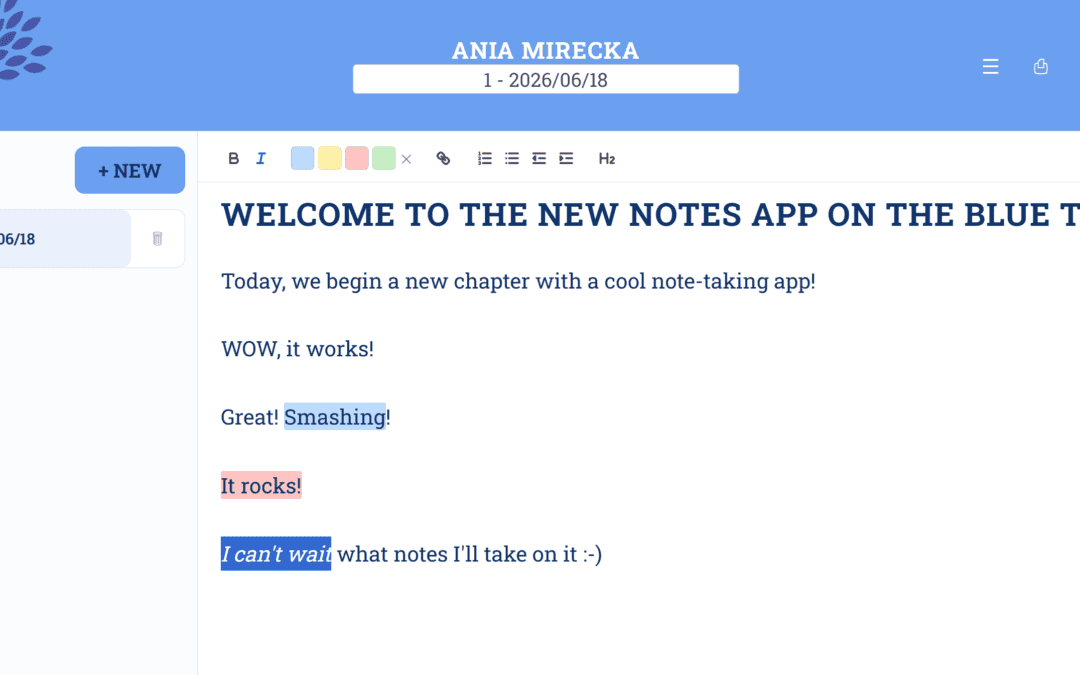
My own note-taking app can now highlight text in four colours, add links and print clean, well-organised notes. That may not sound revolutionary to the people building billion-dollar software platforms in Silicon Valley.
But for me, sitting at my desk after a day that had begun with digital chaos, it felt pretty extraordinary.
It reminded me, in a very small and slightly less glamorous way, of Richard Branson’s stories about Virgin Atlantic. Sometimes a system lets you down, and instead of only complaining about it, you begin asking a different question:
What would it take to build a better alternative?
I am not suggesting that The Blue Tree Notes will soon be competing with Notion, Microsoft or Virgin Atlantic. I do not expect anyone to ask me about in-flight meals or business-class lounges.
But there is something deeply satisfying about solving your own problem.
Clayton Christensen, the thinker behind the idea of disruptive innovation, wrote about the power of simple solutions that begin by serving a real need. Often, the first version does not have everything. In fact, it usually has very little. But it does the important thing well.
That is exactly what I needed.
I did not need a giant, beautiful, feature-packed app with hundreds of options that I would never use. I needed something that would help me work seamlessly during a lesson. Something that would not confuse my learners. Something that would let me focus on teaching rather than wrestling with technology.
Now I have it.
Granted, this is only the first iteration. There will be bugs. There will be ideas for improvement. There will probably be moments when I wonder why I decided to become an English teacher, writer, course creator and part-time software designer all at once.
But that is fine.
Because the first step has been taken.
And perhaps the most interesting part of this story is not even the app itself. It is the fact that this kind of thing is now possible.
A few years ago, building your own application would have sounded almost unimaginable for someone like me. You would need a developer, a team, a budget, a long plan and probably several people using words like infrastructure and scalability while pointing at a large screen.
Today, with a clear problem, a bit of stubbornness, some basic technical understanding, a few hundred złotych and the help of AI, you can go from:
“I wish somebody would build this”
to:
“Right. Let’s build it.”
And that is amazing.
I did not write every line of code alone, sitting in a dark room with seventeen monitors and a hoodie. But I did see the problem. I made the decisions. I asked the questions. I tested the solutions. I pushed the project forward when it got stuck.
That is worth being proud of too.
At the beginning of the day, I had a blocked Notion account, inaccessible notes and a small sense of panic.
At the end of it, I had a working prototype of my own note-taking app inside The Blue Tree.
Not bad for an obstacle.
Maybe that is the lesson I want to remember most from this day. Problems do not always arrive as enemies. Sometimes they arrive disguised as interruptions, failures or closed doors. And sometimes, when we stop staring at the door that has just closed, we notice that it has pushed us towards a path we would never have chosen on our own.
The obstacle is the way.
What a crazy world we live in today, don’t we?