
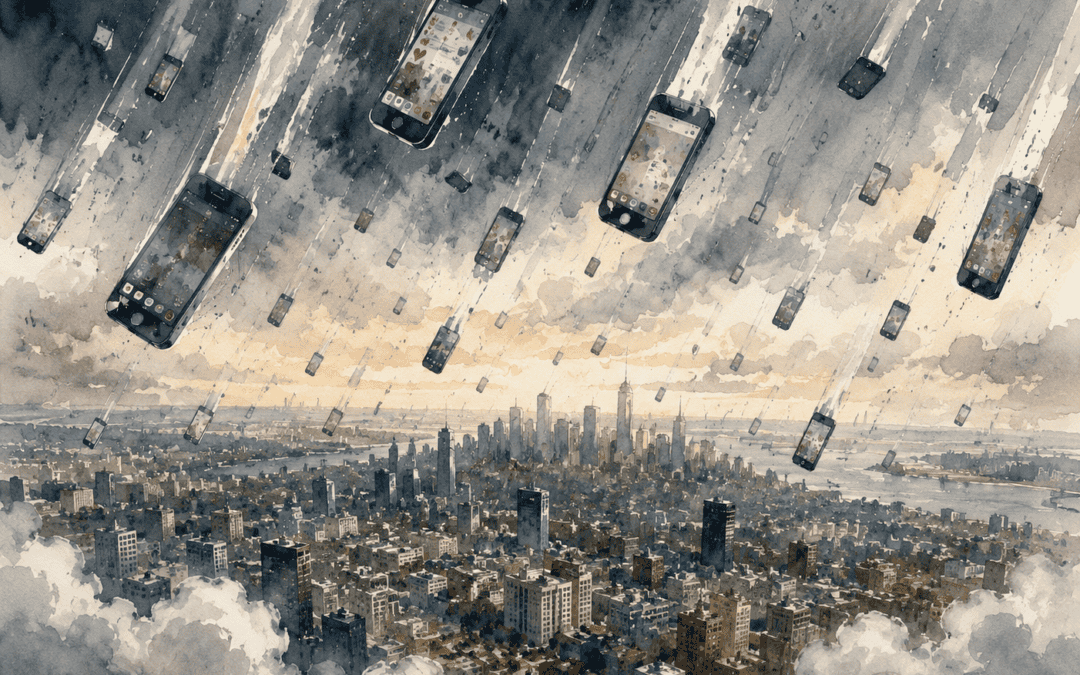
We are screwed
Really screwed.
I know. Not exactly the most sophisticated opening I have ever written. Marcus Aurelius probably wouldn't approve. But after what I saw recently, I honestly can't think of a more appropriate way to put it.
We are screwed.
So many of us have fallen completely for the dopamine delivery system we carry around in our pockets.
Shorts. Reels. TikToks.
Swipe.
Swipe.
Swipe.
Another funny dog. Another angry man explaining why everybody else is stupid. A girl dancing. A war. A motivational quote. Somebody's breakfast. A conspiracy theory. Cristiano Ronaldo. A cat falling off a cupboard.
Swipe.
Another one.
And another.
And another.
Are these things designed to make us wiser?
Are they supposed to help us become better versions of ourselves?
Will humanity one day look back and say: Yes, that was the breakthrough. The 23-second video of a man trying to eat twelve cheeseburgers changed everything?
I don't think anybody has serious doubts about the answers to these questions.
But recently I witnessed something that showed me just how far we have gone.
It happened in a men's toilet.
The last sanctuary
There are rules governing men's toilets.
Ancient rules.
Sacred rules.
You don't talk unless absolutely necessary. You look straight ahead. You maintain appropriate distance whenever architecture permits. And above all:
You don't peek.
Every man knows this.
I was standing at a urinal, peacefully attending to the biological necessities of life, when a young man approached the urinal next to mine.
So far, nothing unusual.
Then something extraordinary happened.
With one hand, he took out the equipment necessary to complete his mission.
With the other...
he took out his phone.
I repeat:
he took out his phone.
And started scrolling.
There he stood. A human being. A creature endowed with reason, imagination, creativity and an extraordinary capacity to learn. A member of the species that built the Parthenon, composed symphonies, wrote The Republic, discovered the laws governing the universe, crossed oceans and landed on the Moon...
and apparently could no longer survive forty-five seconds without Instagram.
One hand controlling the plumbing.
The other feeding the algorithm.
Multitasking.
Twenty-first-century style.
I didn't look, of course.
Rule number one.
But I confess that I activated peripheral vision because my brain simply refused to accept the information it was receiving.
Surely not.
Surely a human being can still urinate without digital stimulation.
Apparently not.
There wasn't even time to be bored.
Not a minute.
Not thirty seconds.
Not even the duration of a piss.
Somewhere between opening his trousers and flushing the toilet, his brain apparently screamed:
QUICK! GIVE ME CONTENT!
And the phone obeyed.
I walked out of that toilet disturbed.
It was funny.
Except that it wasn't.
Then I met Plato's monsters
By coincidence, I've recently been learning about Plato's model of the human soul.
And suddenly the man at the urinal stopped being funny.
Plato asks us to imagine three creatures living inside us.
The first is a Little Man.
He represents logos — reason. The part of us capable of thinking, judging, planning and asking what is actually good for us.
Interestingly, Plato makes him small.
Looking around at the modern world, I'm beginning to understand why.
The second creature is a Lion.
This is thumos — spirit. Courage. Pride. Determination. Anger. Ambition. The part of us that can stand up and say:
Enough.
The Lion is powerful.
But there is a problem.
It can serve either side.
It can become the ally of the Little Man.
Or it can work for the third creature.
And the third creature is terrifying.
A many-headed Beast.
Each head represents an appetite. A desire.
Pleasure.
Food.
Sex.
Money.
Comfort.
Recognition.
Status.
Entertainment.
Not all these desires are evil. Plato wasn't suggesting that we should kill the Beast.
But we have to be extremely careful about which heads we feed.
Because the heads we feed grow stronger.
And we are feeding them
This is where my funny toilet story becomes much less funny.
Social media is an extraordinary machine for feeding the Beast.
Not occasionally.
Constantly.
Every reel is another little portion.
Here you go.
Have some outrage.
Swipe.
Have some envy.
Swipe.
Have some sexual stimulation.
Swipe.
Have some validation.
Swipe.
Have something funny.
Swipe.
Have something frightening.
Swipe.
Have something that confirms what you already believe.
Swipe.
More.
More.
More.
The Beast doesn't even need to ask anymore.
We've built a machine that asks on its behalf.
And then we connected that machine directly to our pockets.
Discipline won't save us
I would love to believe that the solution is simply to strengthen the Little Man.
More reason.
More discipline.
More self-control.
Just put the phone down.
But I don't think that's enough.
James Clear made this point beautifully in Atomic Habits:
“You do not rise to the level of your goals. You fall to the level of your systems.”
If every encounter with my phone requires me to fight a battle of willpower, sooner or later I'm going to lose.
That's not a character defect.
That's a badly designed battlefield.
This is why Clear's idea of identity-based habits makes so much sense to me. Every action becomes a small vote for the person we are becoming.
And suddenly Plato's ancient metaphor feels frighteningly modern.
Every time I automatically reach for the phone because three seconds of silence have become uncomfortable, I'm feeding something.
Every time I interrupt a conversation to check a notification, I'm feeding something.
Every time I reach for stimulation instead of allowing myself to think, I'm feeding something.
Every time I choose outrage because outrage feels good, I'm feeding something.
Every time I scroll instead of sleep...
feed.
Scroll instead of read...
feed.
Scroll instead of talk...
feed.
Scroll instead of think...
feed.
The Beast gets stronger.
And the Little Man?
He gets quieter.
What kind of people are we training ourselves to become?
This question bothers me more than the amount of time we waste.
Perhaps screen time isn't even the biggest problem.
The bigger question is what this constant feeding is doing to our character.
What happens to a person who trains himself every day to expect immediate stimulation?
What happens to patience?
What happens to concentration?
What happens to curiosity that requires effort?
What happens to our ability to listen to somebody who needs five minutes to explain something?
What happens to our tolerance for disagreement when an algorithm learns that anger keeps us engaged?
What happens to humility when we're constantly invited to judge people we know almost nothing about?
What happens to reflection?
To silence?
To self-control?
To the ability simply to sit somewhere and be?
The Bible contains an unsettling description of people in “the last days”. In Paul's second letter to Timothy, he speaks of people who would be self-centred, lovers of money, boastful, unthankful, disloyal, without self-control, fierce, headstrong, puffed up with pride and lovers of pleasures rather than lovers of God.
I have read those words many times.
Recently they have started sounding different.
Not because I think smartphones created those qualities. Human beings managed pride, greed, cruelty and stupidity perfectly well long before Steve Jobs walked onto a stage.
But we may have built something unprecedented:
a system capable of feeding some of our worst appetites billions of times a day.
Individually.
Personally.
Algorithmically.
Feed the right creature
Maybe this is the question I need to start asking myself whenever my hand automatically moves towards the phone:
Which creature am I feeding?
The Little Man?
The Lion?
Or the Beast?
Because James Clear is right. Our actions are votes for the people we eventually become.
One vote doesn't decide the election.
Neither does one reel.
Neither does one wasted evening.
Neither does one moment when we choose stimulation over thought.
But cast the same vote ten thousand times and something changes.
A habit becomes a character.
A preference becomes an appetite.
An appetite becomes a master.
And perhaps one day we discover that the Little Man is still there, somewhere inside us.
He still knows what would be better.
He still occasionally whispers.
The Lion is there too.
Still powerful.
Still capable of fighting.
But both have been neglected for so long that the Beast no longer needs to fight them.
It simply opens another mouth.
And we feed it.
At breakfast.
On the bus.
In bed.
During conversations.
At traffic lights.
Walking through beautiful places.
Sitting beside people we love.
And yes.
Even while standing at a urinal.
Swipe.
Swipe.
Swipe.
Until one day perhaps there will be nobody left inside strong enough to say:
Enough.